


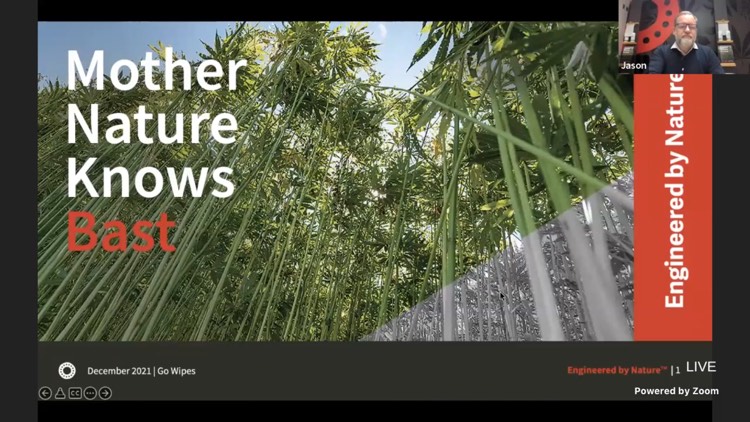
VICTORIA – At this week’s Go Wipes conference, originally scheduled to take place in Amsterdam but reverting to online on December 13 and 14th, Jason Finnis, CTO of Canada’s Bast Fibre Technologies (BFT), outlined the major advantages of natural bast fibres such as flax and hemp.
At present, there is a convergence of demands to eliminate plastics from many products he said, with this push coming both from consumers and brands, backed up by regulations such as the EU’s Single Use Plastics Directive (SUPD) and similar legislation planned in North America and elsewhere.
In response, there is a move towards cellulosics in impacted nonwoven disposables, but Finnis suggested this may eventually just be replacing one problem with another, resulting in issues such as a loss of biodiversity, soil erosion and increased greenhouse gas emissions – especially since wood-based fibres are also being widely adopted in textiles for apparel and the packaging industry.
High biomass
“Bast crops are a high biomass annual crop that can alleviate the growing pressure on global forest resources while absorbing carbon, revitalising soils and preserving biodiversity,” Finnis said. “They are easy to grow and will grow in any climate where soy and corn grows. The lead time is 100 days from the planting to the fibre and these are both summer and winter crops. An acre of land will yield around 1,000 kg of dry fibre.”
BFT operates in the space between the primary processors of bast fibres (decorticators) and nonwovens manufacturers, to provide the industry with carefully individualised and standardised fibres that meet the specific needs of nonwovens producers, cleaning and removing any contaminants and adding and modifying characteristics, with well over 100 critical control points in its processes.
“We are routinely contacted by brands looking for fibre solutions to specific end-product requirements, and in a perfect position to funnel these developments through the nonwovens supply chain,” Finnis said.
The company has been filing patents since 2018 and in 2020 licensed far-reaching global patents from Georgia-Pacific related to incorporating any bast fibre produced, on any nonwoven platform.
The company’s fibres have been successfully qualified on the spunlace systems of both Trützschler and Andritz, at both pilot and commercial scale, and proven to be ‘plug and play’ and bale-for-bale substitutes for viscose, lyocell, polypropylene or polyester.
FVT
In October 2021, BFT announced the acquisition of Faser Veredlung Tönisvorst (FVT), an ISO 9001 certified textile processing facility located in Tönisvorst, near Düsseldorf, in Germany.
The purchase is enabling BFT to immediately increase capacity to meet customer demand for its sustainable bast fibres from the nonwovens industry, following the commissioning of a first-of-its-kind dry fibre processing line, which is providing it with an annual 10-12,000 tons of capacity.
With over twenty years of fibre processing experience, FVT is located within close proximity to both major European centres for bast crop cultivation and nonwoven fabric producers. The transaction follows BFT’s strategy of establishing low carbon, regional supply chains by sourcing, producing and selling within specific regions.
The facility is also ideally equipped for rapid prototyping – from 100g to 1,000kg – and product development of novel fibre modifications to develop natural fibre solutions that meet customers’ specific requirements.
BFT currently has two brands – Sero multi-purpose hemp and Noval linen. Hemp is supplied in slightly thicker micron for a more abrasive hand feel, while Noval is very soft, for a cloth-like feel in nonwoven wipes with moisture management properties.
Questioned about price, Finnis said the fibres are currently in the €3.5-4.5 per kilo range, making them at the high end of lyocell, but processing is still being optimised and the price will lower as additional capacity becomes available.
“Recycling is not an option for nonwoven single-use plastics and our fibres offer soil to soil circularity instead,” Finnis said. “We are just finalising an LCA and confident our fibres can sustainably outperform all others for nonwovens on the market. We will also shortly be announcing a further acquisition that will bring commercial production capacity to the USA.”