


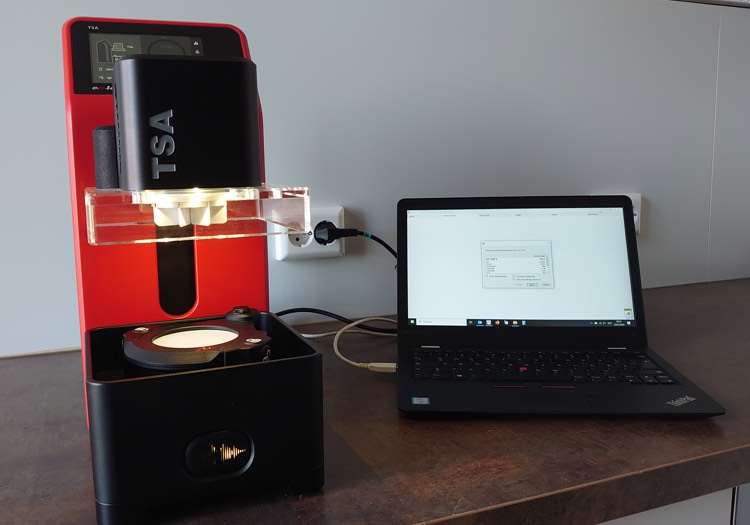
LEIPZIG - Emtec Electronic, the manufacturer of specialised testing equipment for the nonwovens, paper and textiles industries, has launched a redesigned version of its TSA Tactile Sensation Analyzer. The upgraded portable device now includes a new digital database makes the haptic and optical properties of textile samples virtually accessible and easily reproducible.
Much like its predecessor, the new TSA Tactile Sensation Analyzer allows manufacturers to objectively measure the subjective traits that determine the way a material feels to the touch, calculate specific hand-feel values, and reliably compare samples. Now, in addition to measuring the softness, smoothness, flexibility, and deformation/recovery behavior of base and finished products, the redesign also includes surface thermal conductivity and thermal insulation measurement, an improved design for measuring springback behavior, and an integrated high-resolution camera.
For surface thermal conductivity the TSA measures a product’s thermal “handshake,” delivering objective data on how warm or cool a material feels to the touch. This function is steadily gaining in popularity, since it paves the way for the design of innovative speciality products such as recreational clothing that feel cool to the touch even in the blazing sun, or lightweight outerwear that insulates as well as a down parka.
The TSA employs an improved method for measuring springback behaviour, which accurately captures the fabric's ability to return to its original shape after deformation. This feature allows manufacturers to evaluate the elasticity and resilience of textiles, ensuring they meet the desired performance standards.
To digitize optical properties, the camera captures a high-resolution image of the sample, showing in detail the fabric structure, weave, as well as any visual embellishments.
The new version also includes a cloud-based Virtual Haptic Library, an online database, available via license, in which sample data can be digitized, processed, and categorized according to specific haptic and optical traits. Developed in cooperation with Black Swan Textiles, the Virtual Haptic Library can be accessed in real-time by authorized persons from anywhere in the world, enabling efficient quality assurance and control regardless of location. The Library can also be used as an online marketplace, making it easier for textile professionals to find, compare, and reproduce samples with certain haptic requirements.