 An advanced protective suit for health care workers incorporating technology originally developed for cooling patients in cardiac arrest has been developed by a research team at Johns Hopkins University and non-profit health organisation Jhpiego.
It has been selected for federal funding by the US Agency for International Development (USAID) through its new programme, Fighting Ebola: A Grand Challenge for Development.
The suit is designed to do a better job than current garments in keeping health care workers from coming in contact with the contagious body fluids of Ebola patients, both during treatment and while removing a soiled suit. In addition, it is expected to keep the wearer cooler – an important benefit in hot, humid regions such as West Africa.
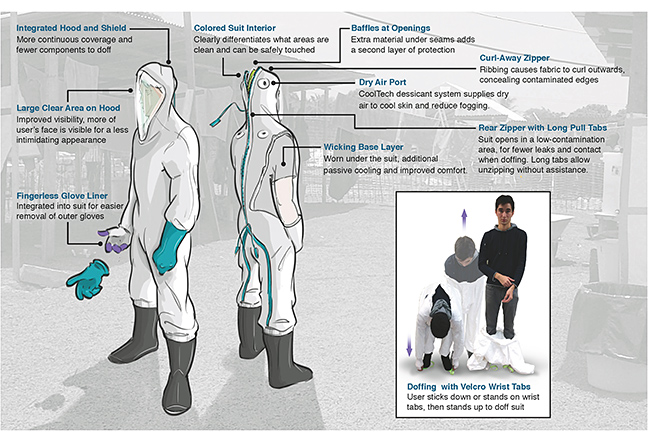
Enhancements include a large clear visor in the hood, which is integrated into the suit, air vents in the hood, a rear zipper to reduce infection risks while removing the garment, a cocoon-style doffing process that requires far fewer steps than existing garments and a small battery-powered, dry air source to cool the user by blowing air into the hood.
“The funding from USAID will support moving our concepts into fully functional prototypes,” said Youseph Yazdi, executive director of the university’s Centre for Bioengineering Innovation and Design (CBID). “This will allow the team to do more detailed evaluations of our concepts, and quickly move to evaluations in the field. By the end of the funded timeline, we will have a product design that is ready to be taken up by a major manufacturer, or several, for large-scale production and distribution. Our goal is to follow the fastest path to get these concepts into the field and having an impact.”