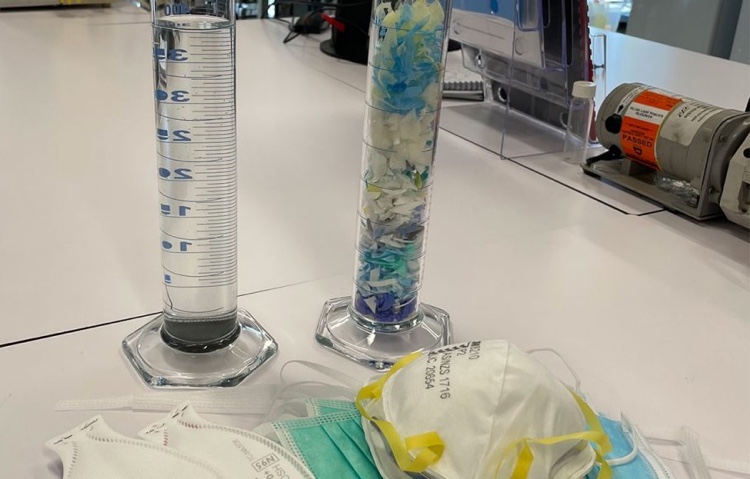
AUCKLAND – A simple method for turning non-recyclable personal protective equipment (PPE) into water and vinegar has been developed in New Zealand.
In a process being fine-tuned at the University of Auckland’s Faculty of Engineering, shredded masks, gowns, gloves and plastic safety glasses are subjected to treatment with hot, pressurised water and compressed air to turn them into water and acetic acid.
The PPE-to-liquid process is carried out at a temperature of 300 °C and takes about an hour in the small prototype machine developed by the faculty.
Gaseous by-products from the process are oxygen and low concentrations of carbon dioxide which can be safely discharged.
“This is a clean, chemical-free solution which will be a game changer internationally,” said associate professor Dr Saied Baroutian. “The technology used is a hydrothermal deconstruction or valorisation process and it destroys the waste completely. The liquid produced in the process is safe, inert and can be reused – the vinegar or acetic acid can be used for disinfecting and the water can be reused for the processing cycle to minimise water consumption.”
The process has been developed at the university in collaboration with the Faculty of Medical and Health Sciences and the Universities of Otago and Waterloo in Canad
It is one of two Auckland solutions that link up to tackle the Covid-19 healthcare waste problem which has been described as “threatening human and environmental health” by the World Health Organisation.
Dr Yvonne Anderson, a senior lecturer at the Department of Paediatrics, University of Auckland, is leading a project that employs dry heat to allopw PPE to be reused or recycled safely.
“By developing two technologies – one for reusable waste and the other for waste that cannot be reused or recycled – we are closing the loop on this ever-growing serious waste issue and providing a circular solution that truly is clean and green,” said Baroutian.
The research teams are now taking steps to develop the solutions into a larger scale pilot system, and learning from that, will develop a full-scale proof-of-concept.
“That is the point where we can showcase the technology, ensure the designs will work with the flow of PPE waste and find funding or potential partnerships with commercial organisations so these technologies can be implemented in New Zealand and overseas,” Baroutian said.
In terms of cost, the researchers have already completed an economic analysis which shows a large-scale hydrothermal deconstruction system could process PPE waste at a cost comparable to the current practice of autoclaving and landfilling.
Funding for the project has been provided through a $1.3 million grant from the New Zealand’s Ministry of Business, Innovation and Employment (MBIE) through the Covid-19 Innovation Acceleration Fund, and a $46,000 grant from the country’s Medical Assurance Society Foundation.