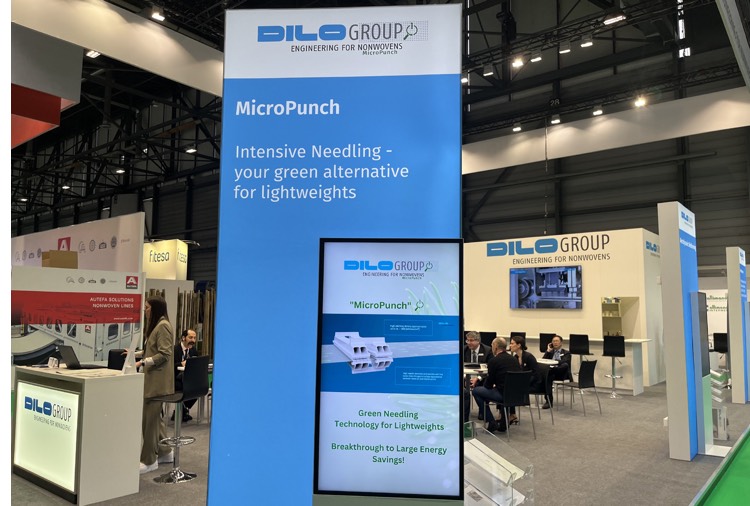
EBERBACH – Dilo is introducing its new MicroPunch needlepunching system, which has been developed as a low-energy alternative to the hydroentangling process, largely for the production of wipes substrates and medical nonwovens with weights below 100gsm.
During a presentation of the German technology during the INDEX nonwovens show in Geneva, the company’s CEO Johann-Philipp Dilo, said that hydroentanglement (or spunlacing) was an extremely energy-intensive process.
“The process is based on high pressure jets which have to be formed continuously and all of that kinetic energy is completely lost,” he said. “In addition, there is continuous water consumption and losses, as well as fibre waste generation.”
Dilo’s Hyperpunch and Cyclopunch machines already operate at speeds of up to 150 metres per minute and stroke frequencies of 3,000 metres per minute.
Continuous waterjets, however, create webs with good abrasion resistance and density and to achieve the same with needling requires needle densities of between 800-900 per square centimetre.
This, incredibly, is what MicroPunch can do.
45,000 needles per metre
It builds on Dilo’s development of high-density boards containing 20,000 needles per metre with barbs of between 20-40 microns, first introduced at ITMA in 2007.
A significant increase in that needle density has now been achieved to up to 45,000 needles per metre of board – making full lines with over one million needles conceivable.
Needle change is greatly simplified with Dilo’s X22 modules which are mounted by sliding into the board and can be selectively changed as needed.
Dilo has all of the data from extensive testing to back up the effectiveness of MicroPunch technology, which it says can save 30% of the cost of hydroentangling a 40gsm nonwoven and 54% of the costs of producing a 100gsm product.
“The electrical energy can be as little as 25% of that required for hydroentangling, with no water or gas consumption and a lower investment cost,” Dilo concluded. “We will be demonstrating it at ITMA 2023 in Milan.”