 German-headquartered chemical giant BASF has signed a research and development agreement with Poietis – the French company aligned to the University of Bordeaux which has developed a 3D laser-assisted bioprinting method for the reproduction of organic tissue.
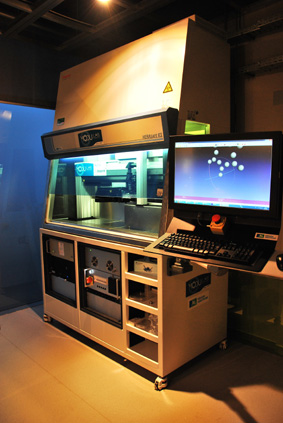
Poietis technology allows for a precise positioning of the skin cells within three-dimensional structures and employing it, cells are now being cultivated with BASF’s Mimeskin skin model, said to be the closest equivalent to the original physiological tissue of human skin.
“We are extremely pleased about this collaboration,” said Dr Fabien Guillemot, founder and president of Poietis. “Having long-term expertise in solutions for the dermocosmetics market, BASF understands the benefits of 3D laser-assisted bioprinting compared to conventional cell culture technologies and other bioprinting methods. The partnership also emphasises bioprinted tissue models as an alternative to animal testing in cosmetics and dermopharmacy.”
The advanced printing resolution of the Poietis bioprinting technology is expected to refine BASF’s Mimeskin and will initially be used for its automated reproduction followed by more advanced models containing additional cell types.
“The partnership with Poietis will allow BASF to secure its strategic advantage in better understanding the skin mechanisms which support the development and testing of advanced cosmetic bioactives for skin care applications,” said Dr Sebastien Cadau, who is responsible for tissue engineering development at BASF.
Poietis was founded in September 2014 following a 2-year project at the Aquitaine Regional Incubator and after winning the French national competition for the creation of innovative technology companies. Poietis benefits from research work conducted at the National Institute for Health and Medical Research (INSERM) and the University of Bordeaux in developing and using 3D laser-assisted bioprinting technology to design, develop and manufacture biological tissues. This technology operates on the principles of 3D printing and proceeds by layer-by-layer assembly of the constituents of biological tissues according to predefined 3D digital design organisations. The technology allows Poietis to produce more complex, robust and customisable tissues than those currently obtained by the conventional methods of cell culture and tissue engineering.