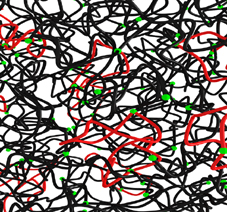
 As long chains of repeating molecules, networks of polymers – both synthetics as well as natural products such as rubber and cellulose – all contain structural flaws at the molecular level.
To form an ideal network, each polymer chain would bind only to another chain, rather than a significant fraction of the chains binding to themselves and forming floppy loops.
Jeremiah A. Johnson, an assistant professor of chemistry and his colleagues at MIT have recently developed a way to measure how many loops are present in a given polymer network – an advance they believe is the first step towards creating better materials that don’t contain them.
Although polymer chemists have known about these loops since the 1940s, they have had no way to count them until now. In a new paper published in Proceedings of the National Academy of Sciences, the researchers explain how they have measured the percentage of loops in a gel, using an approach that could be used for nearly any type of polymer network.
They first design polymer chains incorporating a chemical bond, in a specific location, that can be broken using hydrolysis. Once the polymer crosslinks into a gel network, it is treated with a base that cleaves this chemical bond, known as an ester. (Other degradation methods, such as enzymes or light, could also be used.)
Because they know where the break points are, the researchers can predict the percentages of the four different degradation products they should expect to find in an ideal, no-loop network. By measuring the quantity of each degradation product and comparing it with the ideal, they can figure out what fraction of the polymer formed loops.
They found that the percentage of polymer loops ranges from about 9% to nearly 100%, depending on the concentration of polymers in the starting material and other factors.
“Even in the best material we can make, 9% of its junctions are wasted as loops, which tells us that if can figure out a way to reduce loop formation, we’d have a 9% improvement in material properties,” Johnson says.
Christopher Bielawski, a professor of chemistry at the University of Texas at Austin, says the new technique overcomes longstanding limitations in chemists’ understanding of the exact structures of polymers.
“The technique is a beautiful combination of experiment, theory and state-of-the-art analytics that takes the field a giant step toward sorting out a problem of tremendous importance,” he says.
The researchers are now looking for ways to reduce the number of loops by altering the mixture of polymers used to produce a material, as well as the reaction conditions. They are also planning to use their method to study interactions between cells and biological materials. It has already been shown that at the micron scale, cells behave differently depending on the mechanical properties of their environment, such as stiffness.
The MIT researchers want to look at nanoscale interactions between cells and specific protein sequences found in the extracellular matrix, which provides structural support for cells. They hope to uncover what happens when a cell grabs on to a protein that is looped on itself rather than being attached to the extracellular matrix.
The research was funded by the MIT Department of Chemistry, MIT’s Institute for Soldier Nanotechnologies, and a National Defense Science and Engineering Graduate Fellowship.
Image: Jeremiah A. Johnson and Mitchell Wang