BERKHAMSTED – Composites UK has just launched the latest in its series of good practice guides – The Sustainability of Fibre-Reinforced Polymer Composites.
The chapters within the 130-page document, authored by experts in their respective fields, cover:
- Introduction to sustainability
- Design for circularity
- Life Cycle Assessment - Understanding impact
- Using recycled materials
- Using bio-based materials
- Resource efficiency and processing
- Targets, offsets, reporting and ESG
- End-of-life and recycling
- Policy and legislation
- Next steps and future developments
Production waste
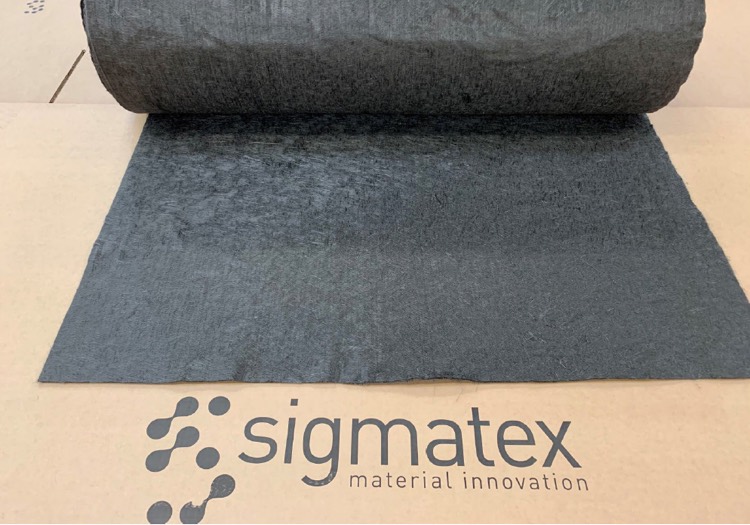
Among a range of case studies highlighted in the guide, is that of the development of carbon fibre nonwovens from production waste by Sigmatex, headquartered in Runcorn, UK.
Up to 30% of all carbon fibre produced ultimately ends up as waste within the manufacturing supply chain, explains Sigmatex lead texile engineer Peter Sestic.
Waste reduction is a major issue in the composites industry and Sigmatex has a strong motivation to minimise its environmental footprint. It has therefore developed a technology to recover its carbon fibre waste and to transform it into nonwoven fabrics. The nonwoven fabric is made from virgin/sized fibre to maximise resin compatibility within the composite stack, as an economical way to add stiffness and bulk.
The fibres are typically 30-70mm in length and are randomly oriented. Significantly, the recycling route can reduce the landfill contribution of Sigmatex by up to 90% (approximately 150 tons per annum).
The developed technology is only a fraction of the size of a weaving machine and adds only marginal additional energy consumption.
“It’s a true win-win situation for the environment and the composites industry,” Sestic notes. “Alongside the technology, product development has grown to a level of consistency, demonstrating that a stable product can be manufactured repeatedly using very traditional textile processing equipment. This includes fibre preparation and machine feeding, carding processes, fibre pile laying and nonwoven bonding and fixation, resulting in 100% recycled carbon fibre nonwovens in various fabric weights depending on the requirement.”
By blending a polymer with the fibre preparation prior to the carding stage, he notes, a thermoplastic product can be made using a variety of chosen polymers and opening up opportunities for thermoformed parts, as well as resin infused items. Wind, automotive and consumer electronics are just some of the industries working with the recycled materials developed at Sigmatex.
The new Composites UK guide is free-of-charge, subject to the completion of a short questionnaire and can be downloaded here.