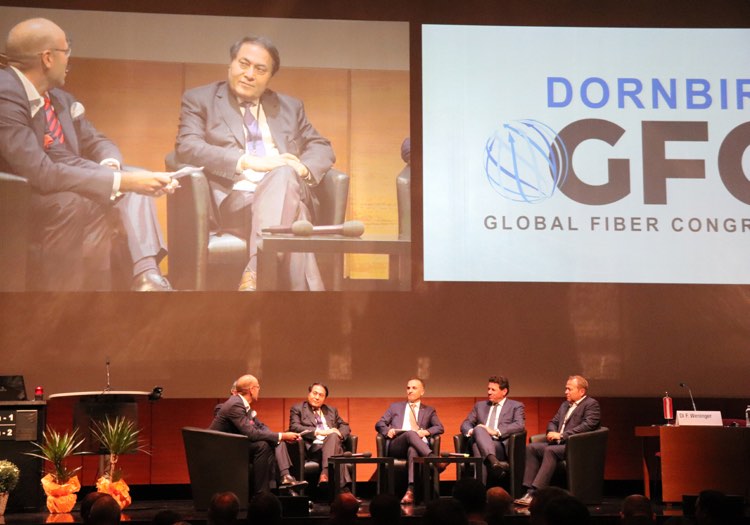
DORNBIRN – The big opportunity for unexplored nonwoven applications as the European Union prepares to introduce new legislation for textile waste will be underlined at the 62nd Dornbirn GFC (Global Fibre Conference) taking place from September 13-15 in Austria.
The conference is being expanded this year to include a total of 120 lectures taking place across four halls over its three days, with keynote speakers on the opening morning from Lenzing, Euratex, Gherzi and energy provider Verbund setting the agenda. The role of digitalisation in the fast-approaching transformation of the textile industry will be outlined in further keynotes from Servicenow and Microsoft, and more than 20 start-ups will introduce their innovations at the 3rd Innovation Days side event, which will be moderated by FashionForGood and PwC (PriceWaterhouseCooper).
Papers addressing the need to accelerate the recycling of textile waste and establish circular supply chains will be presented by technology providers including Andritz, BB Engineering, Gneuss, Hills, Murata and Oerlikon.
In addition to Lenzing, presentations from the fibres and polymer resins side will be made by companies including Arkema, Asota, Avantium, Eastman, Indorama, Kelheim, Nilit, Omya, Radici, Teijin, Toray and Unitika.
Bottleneck
A special block of lectures coordinated by RWTH Aachen University will address the key issue of textile sorting – currently a major bottleneck – with contributions from Texaid in Switzerland and Germany’s Naue, Sojitz, Spinning Solutions and Tomra all outlining the latest progress in technologies in this field.
The fast-rising Scandinavian companies pioneering new fibres from pulped textile waste will also have a strong presence at the conference and will include Infinited, Renewcell, Spinnova and Tree to Textil.
Today only between 30-35% of the annual total textile waste generated in Europe is collected separately and very little of that is returned to fibre form to enable true value retention.
By 2030 the aim is that up to 80% of the total waste will be recycled in some way and that the share of fibre-to-fibre recycling will grow to around 2.5 millions tons.
Even with the latest fibre-to-fibre chemical recycling methods currently being commercialised, only 30-40% content can be incorporated into yarns for conventional spinning and the nonwovens industry is already achieving 100% fibre recycling in many high-value products, which suggests it will play a major role in developments in the next few years, making Dornbirn 2023 a must-attend event.