Neumünster - Oerlikon Nonwoven will present its latest solutions for the filtration industry at the upcoming Filtech exhibition.
Sustainability, quality and efficiency are today’s requirements for systems solutions for filtration applications and their end products. These requirements are covered by the Oerlikon Nonwoven product portfolio with the company set to showcase its meltblown and spunbond portfolio at the show, which takes place in Cologne between February 14 and 16, 2023.
Trade fair visitors will be able to meet the team at Stand B18 in Hall 8 to find out more about the hycuTEC charging unit, this year’s Filtrex Innovation Award winner, among other things.
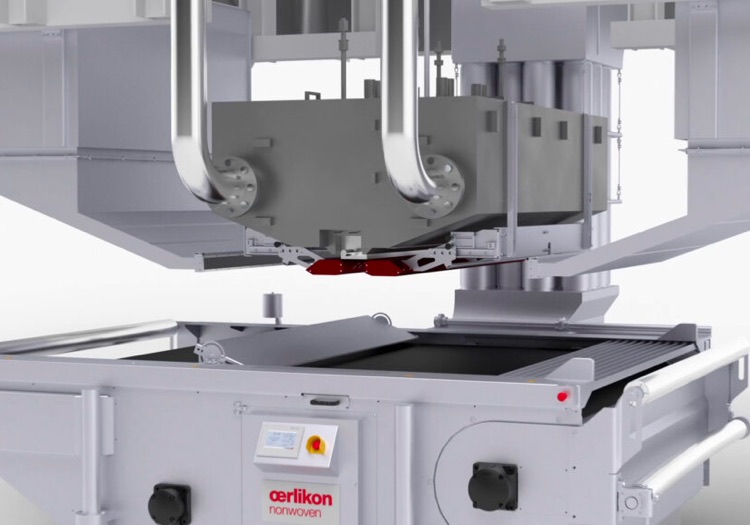
In the case of its hycuTEC hydro-charging solution, Oerlikon Nonwoven offers a new technology for charging nonwovens that increases filter efficiency to more than 99.99%. For meltblown nonwovens producers, this can mean material savings of 30% with significantly superior filter performance. Due to its extremely low water and energy consumption, the hycuTEC is also a future-proof, sustainable technology, as the process can be used without any additional drying steps in the case of most applications.
Bio-based polymers
Oerlikon reports that the bio-based polymer PLA (polylactic acid) is the perfect alternative for those wanting to manufacture sustainable nonwovens and that its meltblown and spunbond technologies are ideally suited for processing PLA, for example. To visualize this, the Neumünster-based systems builder will be presenting medical oronasal masks made from PLA, whose protective effectiveness and wear comfort are equivalent to those of conventional PP masks.
Spunbond
Spunbond products are becoming increasingly important in filtration applications – as backing materials for filter media and as the filter media themselves. The fact that the nonwoven structure can be tailored to specific tasks enables targeted, customer-specific requirements for various functions to be realized. And combining various functions in a single layer is also possible.
The bi-component spinning process enables the creation of completely new nonwoven structures and hence the incorporation of various functions in a single material.
The bicomponent spinning process permits various fibre cross-sections, while standard virgin polymers, bio-based polymers and recycled polyester can be used as raw materials.