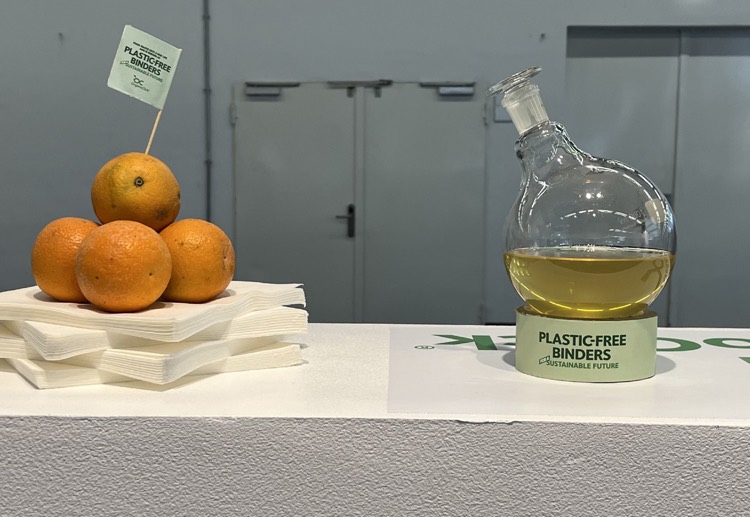
STOCKHOLM – OrganoClick of Sweden has developed a range of 100% bio-based binders for nonwovens that are derived from waste components obtained from residual streams in the food industry such as such as orange peel, shrimp shells and wheat brand, and fully compostable. Common binders are mainly made from fossil-based polymers such as ethyl vinyl acetate (EVA) and acrylates.
The company received the New Technology Innovation Award in recognition of its work at the recent Techtextil show in Frankfurt (June 21-24).
The binders are used to improve the mechanical properties of nonwovens and technical textiles and those that can be enhanced include dry strength, wet strength and dimensional stability, with varying degrees of stiffness or softness. Binders that improve fire protection are also included in the OC-BioBinder range.
The binders can also be used on woven textiles to increase rigidity and prevent wear, which makes them suitable for the manufacture of sunscreens or various home textiles.
They are water-based and applied by either spray impregnation, dip impregnation or coating. After application, the fibre-based material is dried and cured at elevated temperatures.
The binders are adapted for several different nonwoven processes including airlaid, wetlaid, spunlace, spunbond, carded and drylaid. They can also be used with most types of natural fibres, such as wood, cotton, viscose, hemp and pulp and adapted for synthetic fibres such as polyester, PLA, mineral fibres, glass fibres and blended fibres.
Existing products employing the binders are already used in airlaid napkins and tablecloths, wetlaid agricultural sheeting, wetlaid hygiene products and in knitted textile inserts.
OrganoClick is currently involved in a large number of late-stage development projects with customers, including Swedish tableware specialist Duni.
During 2021 the high performance quality Duni was aiming for was realised, enabling it to launch the world’s first entirely fossil-free and 100% home compostable premium napkins for the restaurant industry.
Together with Ellepot, of Esbjerg, Denmark, and Ahlstrom-Munksjö, OrganoClick has also developed 100% biobased and biodegradable nonwoven plant pots for the horticulture market. Launched by Ellepot in 2021, the Organic 2.0 paper pot is a completely organic and fully compostable product for growing crops on an industrial scale. Unlike other products on the market, it contains no hidden plastic, so does not add microplastics to the soil.