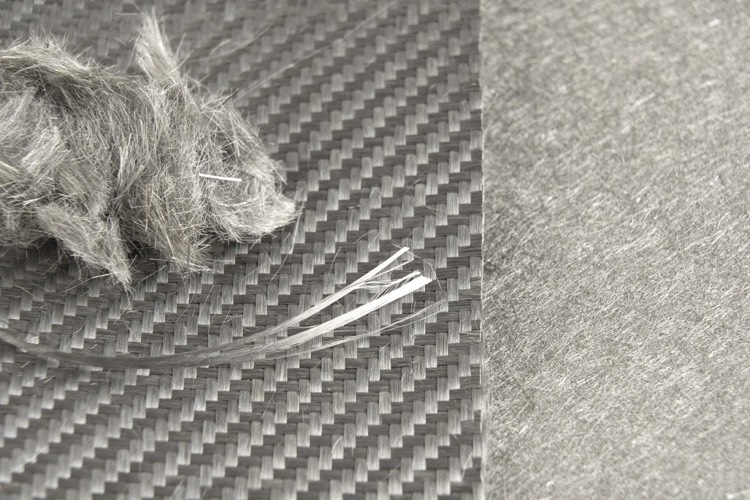
FRANKFURT – Both nonwoven and woven fabrics have already been produced with AluCoat, a new fibre which combines the strength of basalt with the electrical conductivity of aluminium.
Among many potential applications, the aluminium-coated basalt fibre will provide electromagnetic shielding as wallpaper – in buildings such as hospitals or server farms – that is 20 times cheaper than conventional aluminium foil, according to Fibrecoat, based in Aachen, Germany.
Fibrecoat and Deutsche Basalt Faser of Sangerhausen, Germany, received the 2022 Techtextil New Technology Innovation Award at the exhibition held in Frankfurt from June 21-24 for AluCoat’s development.
It is produced on standard glass and basalt fibre spinning lines to which a coating module is added below the fibre formation area, enabling the coating of each individual filament with liquid aluminium.
Due to the high speed of the process, the low diameter fibres cool quickly and a sizing can be applied and adapted to meet different industry requirements such as processability, adhesion, separation etc. Subsequently, the fibres are wound on to a bobbin for further processing.
The filaments spun with the FibreCoat process have a diameter of 23μm and can be supplied in different yarn counts ranging from 30 to 600 dtex. The resulting yarns have high mechanical properties because of the basalt core as well as a high thermal and electrical conductivity due to the aluminium coating. All materials used in the production are non-flammable and the material itself is fire resistant and heat resistant to 500 °C and although AluCoat is a composite fibre, recycling is not a problem.
AluCoat yarns can be used like cables for energy/data/signal transmission or used on substrates to generate conductive paths. The yarn can be chopped into different fibre lengths for the use as short or long fibre reinforcement, adding conductive and EMI shielding properties to the resulting composite parts. In addition to different nonwoven and woven fabrics Fibrecoat plans to produce braids and knitted textiles in the near future. While every textile form comes with different properties, they can all cover a spectrum of properties on porosity, EMI shielding, heat conduction, antimicrobial and strength. In addition, these fabrics can be used in composites where the aforementioned properties are retained and applied. The aluminium surface of the fibres is dyeable through anodization, making the fabrics and composites a viable material for design applications with a need for metal shine.
“We are honoured to receive this prestigious award,” said FibreCoat CEO Robert Brüll. “In particular, the confidence of our customers and visibility gained as a result are crucial for a start-up like FibreCoat on the road to market success.”