FRANKFURT – The aim of RBX Créations, based in Neuillac, France, is to directly combine the supply chain for producing hemp oil with that for hemp fibres for nonwovens and textiles, in order to maximise the use of arable land.
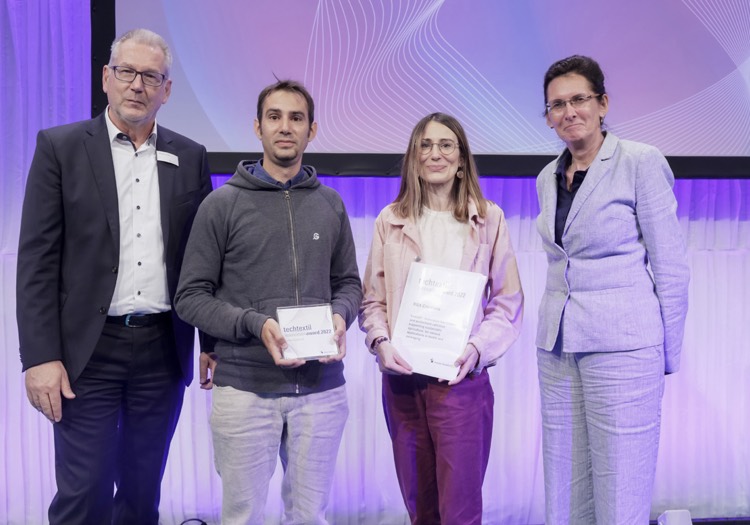
The company received the 2022 Techtextil New Material Innovation Award at the exhibition held in Frankfurt from June 21-24 for its development of Iroony-branded fibre, which is made possible by a new process for extracting cellulose from the waste of oilseed hemp.
The company’s founders, Charles and Anne Reboux (pictured at the Techtextil awards ceremony with Messe Frankfurt’s Michael Janecke and STFI’s Heike Illing-Günther), point out that France is the largest European producer of hemp. The plant grows quickly, generally without irrigation or chemicals, while welcoming biodiversity and massively capturing carbon. In rotation cycles it helps regenerate soils and improves crop yield.
The use of oilseed hemp for fibres enables farmers to combine the markets for the seeds – health food and cosmetics – while RBX Créations collects the stems for Iroony, resulting in an optimised use of arable land.
Biochemistry is employed to extract the different components from the stems, most notably the cellulose. A patent-pending process is then employed to transform the hemp cellulose into fibres, through dissolution and regeneration technologies.
The company is employing the safe and clean HighPerCell technology patented by DITF Denkendorf in Germany and based on ionic liquids as a direct solvent process. For the filament spinning, RBX Créations partnered with DITF through the ELIIT European programme.
The goal now is to set-up a new value chain starting from the farmers, and RBX Créations will also valorise the co-products of its process and recycle the solvents for enhanced circularity.
“The dependency of Europe for the supply of strategic materials has been highlighted by the Covid crisis and being able to produce yarns and fabrics with local fibres is the key to resiliency,” says Anne Reboux.