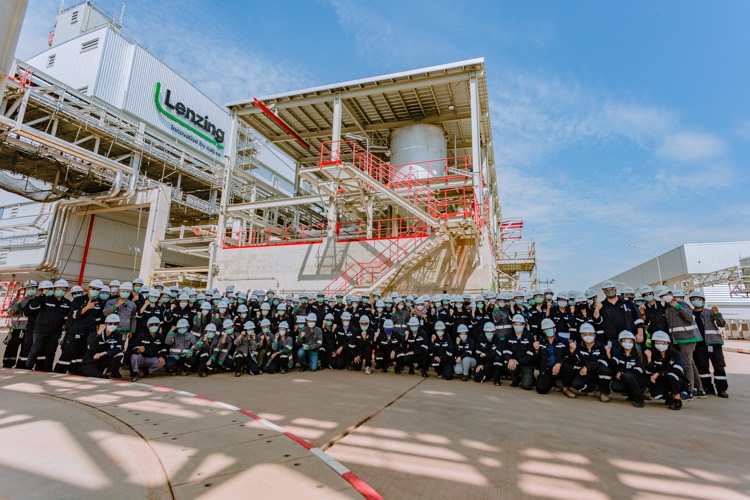
PRACHINBURI – The Lenzing Group has announced the successful completion of its €400 million lyocell expansion project in Thailand, a new facility that will act as platform for further expansion in the region for its range of sustainable fibres including Tencel, Lenzing Ecovero and Veocel.
The new plant, the largest of its kind in the world with a capacity of 100,000 tons per year, started production on schedule and will specifically help Lenzing meet the increasing customer demand for Tencel branded lyocell fibres.
For Lenzing, the project also represents an important step towards strengthening its leadership position in the specialty fibre market and into a carbon-free future.
The construction of the plant located at Industrial Park 304 in Prachinburi, around 150 kilometers northeast of Bangkok, started in the second half of 2019 and proceeded largely according to plan, despite the challenges arising from the Covid-19 pandemic.
Welcoming the start up of the plant, Cord Prinzhorn, CEO of Lenzing Group said the company was very proud of this achievement. "Our sincere thanks go to the entire Lenzing team and especially to our staff in Thailand but also to many external stakeholders, who joined forces in times of a global pandemic to make this key project reality," he said. "To deliver such a huge project in time and at budget is an outstanding achievement given the challenges of the global pandemic."
Robert van de Kerkhof, Member of the Managing Board, agreed, adding: “The demand for our wood-based, biodegradable specialty fibers under the Tencel, Lenzing, Ecovero and Veocel brands is growing very well. In Asia in particular, we see huge growth potential for our brands based on sustainable innovation.
"With the production start of the lyocell plant in Thailand, Lenzing reached an important milestone in its growth journey, supporting our ambitious goal to make the textile and nonwoven industries more sustainable.”
According to Lenzing, the lyocell production process is the most modern method for producing fibres from wood. It has been successfully applied on an industrial scale for about 30 years and is particularly environmentally responsible. The underlying idea of the lyocell process is to dissolve and process the pulp in a closed loop without any chemical derivatisation.
The company says it will continue to expand its production capacity for lyocell fibres in line with its sCore TEN strategy, which aims to generate 75 per cent of its fibre revenue from eco-responsible speciality fibres such as Tencel, Lenzing Ecovero and Veocel fibres by 2024. The Thailand site offers space for several production lines. The investment in the first phase already includes general infrastructure that would benefit future expansion. However, Lenzing will continue to look for opportunities to expand lyocell production in other parts of the world too.
“Investments in Thailand and other Lenzing sites around the world support us not only along our transformation towards becoming a supplier of eco-friendly specialty fibres but also in implementing our ambitious climate targets, thus further increasing our company value,” added Prinzhorn.
In 2019, Lenzing made a strategic commitment to reducing its greenhouse gas emissions per ton of product by 50 per cent by 2030. The vision is to be climate-neutral by 2050. Due to the established infrastructure, the site in Thailand can be supplied with sustainable biogenic energy and contribute significantly to climate protection.
Together with the key project in Brazil and the substantial investments at the existing sites in Asia, Lenzing says it is currently implementing the largest investment program in its corporate history (with more than approx. €1.5 billion). It will continue to drive the execution of its strategic projects, which are to make a significant contribution to earnings from 2022.