CAMBRIDGE – Xampla is commercialising an advanced process for structuring plant proteins – without any chemical modification or synthetic addition – into functional plastic-like materials.
The supramolecular engineered proteins (SEPs) have been developed over the last fifteen years at University of Cambridge and Xampla is focusing on replacing today’s microplastics and single use applications with them.
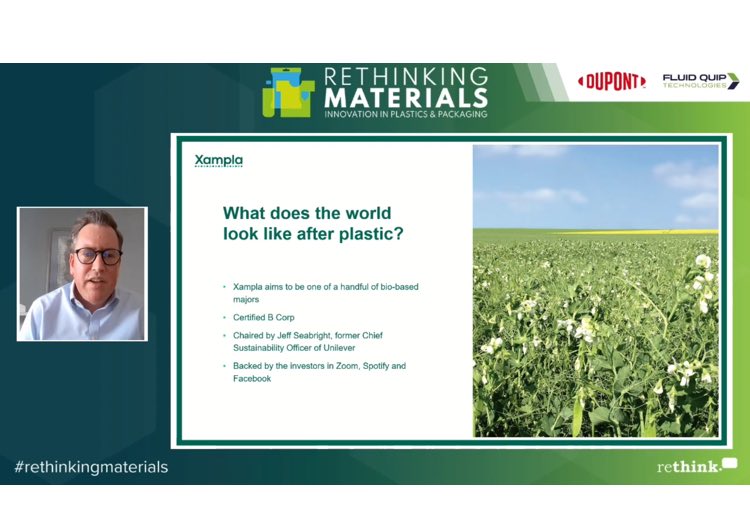
“Our aim is to be a leader in this race, which is happening right now, by looking at what the world looks like after plastic,” said CEO Simon Hombersley, speaking at the recent Rethinking Materials online conference held from May 19-20. “Plastics have had a hugely positive impact on the world and unfortunately a less positive one too, but they have only been in existence for a lifetime and by 2040 there will be far fewer of them around. We believe the value chain for alternatives to plastics will be much like the industry today, dominated by just a few big companies, and we aim to be one of them.”
B Corp
As the first university spin-out to become a Certified B Corp, Xampla joins the growing list of companies legally required to consider the impact of their decisions on workers, customers, suppliers, community and the environment.
In January this year, the company closed a £6.2 million seed finance round led by the backers of Zoom and is being chaired by Jeff Seabright, the former chief sustainability officer of Unilever.
“We have developed a plant-based product which degrades completely naturally at end of life,” Hombersley said. “It’s actually an edible material, unlike most of the polysaccharide materials out there at the moment, which require crosslinking. It’s a scientific breakthrough that comes from the high performance of protein. Silk is a protein material and that’s where the development of this process started.”
The company’s production process is also fully scalable, he added.
“Essentially these are very big problems we’re seeking to solve so there’s no point in doing it if you can’t scale your production. Our focus is on microplastics and we have a lead customer in edible microcapsules for nutrients going into soft drinks. That’s a unique product, but we’re also focusing on fragrance microcapsules, driven by the European Chemical Agency’s microplastics ban which is a huge commercial opportunity for us to disrupt a number of different sectors in personal care and home care.”
Drop ins
Another initial application will be in single-use sachets.
“Unilever uses 50 billion single-use sachets a year for personal care alone and they are currently not easily recycled,” said Hombersley. “The edible nature of our product is significant, because what is an edible plastic? It’s not a plastic anymore, it’s a food, and as we move towards new materials that are replacing plastics, the lines between packaging and food and format will all be changing. We’re particularly interested in those format change applications, so soluble packaging is an obvious one.”
The new Xamla sachets are drop-ins for existing roll to roll plastic casting applications and one product to already arise is an edible, cookable stock cube package that can be simply dropped in the cooking pot.
“That’s just one example of the format change products we’re looking to develop with forward-looking companies,” Hombersley said in conclusion. “We have a highly-defensible technology and we are currently building a commercial team, recruiting a lot out of P&G and Unilever, and we’ve already got some initial customer traction with our pellets and resins as drop in solutions as the way to scale.”
Web: www.rethinkingmaterials.com
Web: www.xampla.com