ECULLY - A new dry, bio-based, electrospun beauty mask has been shown to reduce the presence of forehead wrinkles and crows-feet around the eyes and to moisturise the skin effectively in trials on human volunteers.
Conventional beauty facial masks are made of nonwoven structures soaked with active ingredients. If preservatives are not used, however, ingredients such as antioxidants can degrade even before the mask is used, reducing their effectiveness. Active ingredients are more stable in dry-state face masks, but it can be difficult to distribute them homogeneously in such electrospun matrices.
A European consortium of researchers claim to have solved these problems, while creating a highly effective beauty mask, by electrospinning nonwovens of a polymer called pullulan and embedding active ingredients within them using a dry-powder impregnation process developed by Fibroline of Ecully, France.
The researchers working with Fibroline are from Bioinicia and the Institute of Agrochemistry and Food Technology (IATA), both of Valencia, Spain, and the INSTM in Florence, the University of Campania in Naples and the University of Pisa, all in Italy.
Pullulan is an edible, odourless and almost tasteless polysaccharide polymer that is produced from starch by the fungus Aureobasidium pullulans. It is principally used in the manufacture of edible films for breath-freshener and oral hygiene products, and for the manufacture of skin-care products. It is highly hydrophilic, enabling it to retain water instantaneously when humidified, and dissolves quickly to a cream-like consistency when wetted. Due to the low density of the polymer, electrospun nonwovens of pullulan are able to hold large amounts of active ingredients (in the case of this study, about 12% by weight).
For their active ingredients, the researchers chose complexes of chitin nanofibril-nanolignin-glycyrrhetinic acid (CLA). Chitin nanofibril (CN) is a non-toxic crystalline polymer derived from crustacean waste and imparts a moisturising effect. Nanolignin (NL), a negatively charged by-product derived from forestry, agricultural and food-waste, is reported to demonstrate antioxidant and photoprotective properties due to its high phenolic content. Glycyrrhetinic acid (GA), meanwhile, is extracted from the liquorice plant and demonstrates antioxidative, anti-inflammatory and antimicrobial properties.
Dry-powder impregnation technology enables these ingredients to be impregnated into the nonwovens homogeneously, without affecting the integrity of their electrospun structure.
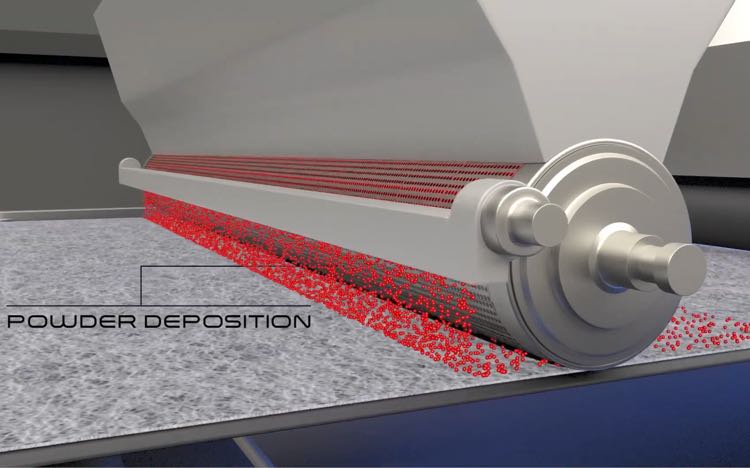
In the basic configuration of Fibroline’s process (D-Preg), a scattering unit deposits dry powder onto a porous substrate travelling below. The substrate and powder then pass between two electrode plates, which are connected to a low-current, high-voltage generator that produces an alternating electrical field in the intervening space.
The alternating field first electrically charges the dry particles in the powder and then attracts them, pulling them into the substrate. Fibroline says that no heat is required and there is no rise in temperature during processing, which takes place at room temperature.
The researchers report that the beauty mask performs well in in vivo testing and say that their work has enabled the production of an environmentally sustainable and bifunctional cosmetic product, providing an effective alternative to current products.
Jérôme Ville, CEO of Fibroline, will describe the benefits of dry-powder impregnation technology at the Smart Nonwovens for High-performance Applications seminar, which will take place at the INDEX nonwovens show in Geneva, Switzerland, on 8 September 2021.
www.fibroline.com