
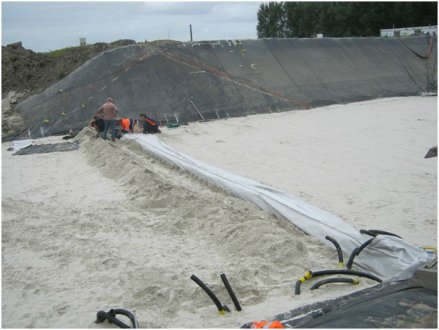
 A vertical sand-tight geotextile made by TenCate has won the Dutch Water Innovation Award for 2013 in the category ‘Dry Feet’.
‘Piping’ is a major failure mechanism in dykes, in which water seeps through an embankment, dyke or other engineering structure as a result of a huge difference in the level of the water on either side.
The flow of water under the dyke may be so great that sand boils that carry along sand particles occur on the polder side of the dyke. As a consequence, the so-called ‘pipes' – tubular openings – are created under the dyke that may cause it to burst.
Vertical sand-tight geotextiles are an innovative preventive measure used to avert piping. They have been developed and tested by the Rivierenland Water Board working with Deltares – the Department of Waterways & Public Works in the Netherlands – and TenCate Geosynthetics.
The geotextile filter allows water, but not sand, to pass through, ensuring the sand remains trapped under the dyke and that piping cannot occur. This solid solution is not dependent on a minimum requirement for seepage length. The technique was derived from TenCate Geotube technology.
In addition, by combining this geotextile preventive measure with TenCate GeoDetect technology, the functionality of the filter is combined with sensors, which monitor the stability of the dyke. Both the vertical sand-tight geotextile and GeoDetect are solutions which, due to the small amount of space they occupy, will increase both the feasibility of dyke improvement and cost effectiveness. In principle geotextile solutions for water management have a low carbon footprint. They are sustainable and durable alternatives to traditional solutions used in dyke improvement and land reclamation.
Annemieke Nijhof, chair of the Dutch Water Innovation Award jury called the product “the most innovative idea that can be used within the duties and responsibilities of Dutch water boards’.