 The Euro VI standard for exhaust emissions which is being introduced in 2014 is making new demands on nonwoven filter manufacturers who supply to commercial vehicle and truck builders.
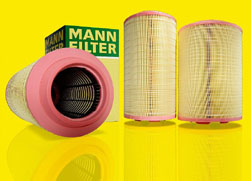
Mann+Hummel, based in Ludwigsburg, Germany, is responding to the tighter regulations with highly efficient nanofibre coatings on its new Micrograde A-NF filter medium for new light to medium-weight trucks in the independent aftermarket.
Dusty or sooty air is a fact of life on construction or mining sites, where trucks are used under extreme conditions and efficient air filters are needed to protect the engines and their components from increased wear and malfunctions.
To comply with emissions levels, truck manufacturers are increasingly installing more air flow meters in their commercial vehicles, but these sensors only work properly when the engine intake air is free of pollutants.
Micrograde A-NF filters are already used on the small and medium-sized TGL and TGM truck models manufactured by MAN and nanofibre air filter media for the independent aftermarket for DAF's mid-range CF trucks are also supplied.
Micrograde A-NF media consist of a cellulose carrier material coated with extremely thin layers of ultra-fine polymer fibres with an an average diameter of 0.15 micrometres or 0.00015 millimetres. This makes them up to 500 times finer than a human hair and up to 300 times finer than the fibres in the carrier material.
As a result, the surface on which dust particles can be deposited is much larger, making the filter much more efficient. Mann+Hummel has proved this in laboratory tests using fine particles with a diameter of 0.7 micrometres (0.0007 mm).
Using the pure carrier material without nanofibres, the filter media retains 40% of all particles of this size. The separation efficiency increases to up to 99.98% when filtered through the fine-mesh nanofibre layers. Micrograde A-NF therefore filters almost all of even the tiniest particles from the intake air and the dirt particles attach to the surface of the medium. The advantage of this is that the particles cannot penetrate the cellulose base medium and block the pores there. Long service intervals are therefore a further benefit.
Despite its high separation efficiency levels, the flow resistance of Micrograde A-NF, however, is very low. The small diameter of the nanofibres has a positive effect here. The diameter of the fibre is also a key factor in the stability of the nonwoven and thus in preventing tears and cracks.
Mann+Hummel has developed specific software for checking and assessing the nanofibres which can be used to automatically determine the diameter of the fibres using pictures from a scanning electron microscope. This solution is just one of the many patent applications the company has filed with the German Patent and Trade Mark Office (DPMA). Having submitted 114 applications in the past year, the DPMA lists Mann+Hummel among the most active domestic patent applicants.