 There are now an estimated 320 million tons of discarded plastics in the world’s oceans and hygienic disposables based on nonwovens have certainly contributed to this environmental problem.
Speaking at the official launch of the Healthy Seas Project in Slovenia on Friday (4th October), Heather Koldewey of the Zoological Society of London said that more plastic has been produced in the last ten years than in all of the 20th century, including an annual 500 billion disposable shopping bags – a million of which are discarded after just 15 minutes of use – as well as 35 billion plastic bottles which are discarded each year in the USA alone.
This has resulted, among other things, in the phenomenon known as the Global Pacific Garbage Patch – an area twice the size of France which is a dense soup held in place by a vortex in which there’s just 1kg of planton to every 6kg of plastic.
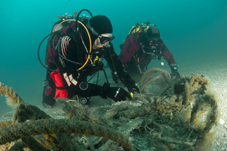
The Healthy Seas Project is focused on a specific area of oceanic waste – abandoned fishing nets which can be successfully regenerated back into polyamide 6 fibre.
When such ‘ghost nets’ are discarded, they don’t effectively stop fishing, and are reported to be responsible for the deaths of around 130,000 whales, dolphins and porpoises in addition to 40,000 fur seals and many other sea creatures every year.
“Fish are wildlife and some face extinction,” said Koldewey. “The tuna for example, is now more endangered than the panda and fisheries are the greatest threat to ocean life, followed by this pollution.”
The Healthy Seas Project project brings together the Netherlands-based European Centre for Nature Conservation, Italian polyamide manufacturer Aquafil and Starsock, a leading development and production partner for socks, also based in the Netherlands. In addition to the Aquafil Econyl plant in Ljubljana, the Fonda sustainable fish farm and the Ajdovscina waste treatment centre are also heavily involved in the project within Slovenia.
At the Econyl Ljubljana plant, Aquafil has invested some €20 million in the development of its depolymerisation technology over the past four years and has subsequently recovered some 12,000 tons of caprolactam for making polyamide in a cradle to cradle process. This has already been used in products ranging from Adidas and Arena sportswear to Interface floorcoverings.
The first commercial product specifically from the fishing nets reclaimed by the Healthy Seas Project will be a Starsocks range introduced in Kaufland stores in Europe in May 2014.
Full story in the next print issue of Sustainable Nonwovens.