
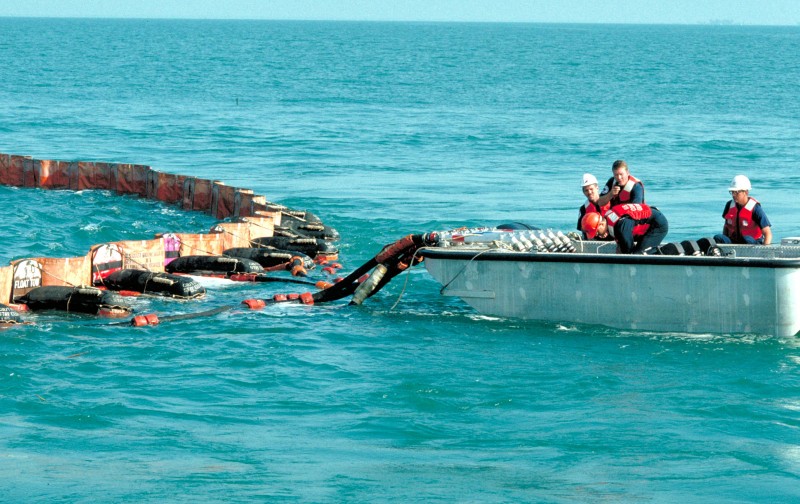
 The Oil Spill Control business today is highly profitable for a number of nonwovens manufacturers and those specialist converters who turn them into oil sorbents.
This industry largely originated in the USA, with oil sorbents first pioneered by 3M and Conwed. Prior to this detergents were used to sink the oil, which was hardly satisfactory, and meltblown proved a very viable solution, being naturally hydrophobic and floating on water.
At the time of the BP Gulf of Mexico oil spill in 2010 there was a clamour to offer a number of alternative solutions, but these were prevented from use by US regulations which currently specify polypropylene spunmelt materials for the job.
In the latest development, however, research conducted at the Nonwovens and Advanced Materials Laboratory at The Institute of Environmental and Human Health (TIEHH) shows that low-grade cotton is also highly effective at absorbing crude oil spills.
The study, published in the most recent issue of the American Chemical Society journal Industrial & Engineering Chemistry Research, reveals that a pound of low-micronaire cotton can absorb more than 30 pounds of dense crude oil. In addition, the natural waxiness of raw, unprocessed cotton fibre keeps water out, making cotton an efficient and effective material for addressing ocean-based oil spills.
Supported in part by Cotton Incorporated, the study includes some of the first scientific data on unprocessed cotton’s use as a crude oil sorbent.
“About ten per cent of the cotton grown in West Texas is low micronaire,” says Dr Seshadri Ramkumar, lead author of the study and manager of the Nonwovens and Advanced Materials Laboratory. “It doesn't take a dye well, so it has little value as a textile fibre. However, because it is less mature, more of it can be packed into a given area. We show through sophisticated testing that low-micronaire cotton is much finer and can pick up more crude oil. In contrast to synthetic sorbents, it is an ecologically-friendly sorbent for oil spill cleanups.”
Dr Kater Hake, senior vice-president of Agricultural and Environmental Research at Cotton Incorporated lauded the findings as the latest example of cotton’s environmental progress.
“Cotton research over the past twenty years has enabled cotton growers in the US to significantly reduce pesticide and irrigated water applications, and has provided access to the nutritional benefits of cottonseed. The use of low-micronaire cotton to combat crude oil spills is another example of how the industry is eliminating waste and maximising the environmental value of cotton."
Strict rules on the treatment of the used booms for oil spills, however, have consequently been imposed in the USA, with incineration as a highly suitable option due to the low ash content of the used materials. Strict limits on their disposal at landfill are also now in place.
Current oil absorbing booms are in many cases currently made from polypropylene meltblown trim – as the by-product from other production which would otherwise be waste. Their outer casing is generally PP spunbond. They can absorb up to 25 times their own weight and can be up to around ten feet long – beyond which they become too heavy to be effective.
Sorbent products are now colour coded by product function – blue for oil selective, grey for their suitability for absorbing all fluids and yellow for dealing with acids and bases
US developed regulations in respect of their use have subsequently transferred to the UK and Europe, and are now gradually being adopted throughout Asia too.
The BP spill was not at all an isolated incident. There are reported to be an estimated 500 spills around the harbours of China annually and the problem in Russia is said to be so severe that there is the equivalent of seven of the 2010 BP disasters in the country’s waters each year.