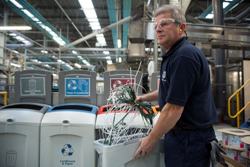
 More than 50% of all Unilever factories achieved the goal of sending no waste to landfill in 2012, even as the company reported annual sales of €51 billion, up from €40 billion when it set out its vision of doubling the size of its business while reducing environmental impact.
Unilever has already reached the milestone of 100% of sites sending zero waste to landfill in 18 countries – the equivalent of removing more than one million household bins of waste every year.
Over 130 Unilever factories across the world send no non-hazardous waste to landfill and a key driver for this has been the elimination of waste in the factories. Additionally, waste is reduced, reused, recycled and recovered. Under its Sustainable Living Plan, Unilever announced that by 2020, total waste sent for disposal would be at or below 2008 levels – despite producing significantly higher volumes. Now the company is bringing the 2020 commitment five years forward. A total of 252 factories across the world will not send any non-hazardous waste to landfill by end of 2015.
“This demonstrates how our factories are more environmentally responsible, which is helping us to save money to invest in our business. Having over 130 sites not sending waste to landfill equates to a cost saving of almost €70 million – all achieved without the need for capital expenditure,” said Tony Dunnage, Unilever Eco-Efficiency Manager. “By using the ‘design once and deploy everywhere’ philosophy, the company is driving a sustainable model that is good for the environment and saves costs. Every new factory will produce 50% less waste than five years ago and will not send any non-hazardous waste to landfill by design.”
Where reduction of waste is not sufficient it will reuse, recover or recycle waste. For example, in Russia Unilever collects a few tonnes of perforated outer-tea bags annually and this is sold in pet shops as animal bedding, used for wallpaper, etc. In Hefei (China) Unilever reduced plastics to wrap boxes on pallets by replacing it with reusable elastic fabrics.