 The Bill and Melinda Gates Foundation has awarded a University of Washington research team almost US$1 million to further develop the technology for employing nanofibre nonwovens to simultaneously both offer contraception and to prevent the HIV virus.
Currently, the only way to protect against HIV and unintended pregnancy is the condom, which is an effective technology but not appropriate or popular in all situations. Nanofibre nonwovens may be the future alternative.
“Our dream is to create a product women can use to protect themselves from HIV infection and unintended pregnancy and we have the drugs to do that,” says Kim Woodrow, a UW assistant professor of bioengineering. “It’s really about delivering them in a way that makes them more potent, and allows a woman to want to use it.”
At a lab meeting last year, Woodrow presented the concept, and co-authors Emily Krogstad and Cameron Ball, both first-year graduate students, pursued the idea.
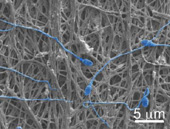
They first dissolved polymers approved by the Food and Drug Administration and antiretroviral drugs used to treat HIV to create a solution that passes through a syringe. As the stream encounters the electric field it stretches to create thin fibres measuring 100 to several thousand nanometres that whip through the air and eventually stick to a collecting plate. The final material is a stretchy fabric that can physically block sperm (as pictured) or release chemical contraceptives and antivirals.
“This method allows controlled release of multiple compounds,” says Ball. “We are able to tune the fibres to have different release properties.”
One of the fabrics they made dissolves within minutes, potentially offering users immediate, discrete protection against unwanted pregnancy and sexually transmitted diseases.
Another dissolves gradually over a few days, providing an option for sustained delivery, more like the birth-control pill, to provide contraception and guard against HIV.
The webs could incorporate many fibres to guard against many different sexually transmitted infections, or include more than one anti-HIV drug to protect against drug-resistant strains (and discourage drug-resistant strains from emerging). Mixed fibres could be designed to release drugs at different times to increase their potency, like the prime-boost method used in vaccines.
The electrospun webs could be inserted directly in the body or be used as a coating on vaginal rings or other products.
Electrospinning has existed for decades, but it’s only recently been automated to make it practical for applications such as filtration and tissue engineering. This is the first study to use nanofibers for vaginal drug delivery.
While this technology is more discrete than a condom, and potentially more versatile than pills or plastic or rubber devices, researchers say there is no single right answer.
“At the time of sex, are people going to actually use it? That’s where having multiple options really comes into play,” Krogstad said. “Depending on cultural background and personal preferences, certain populations may differ in terms of what form of technology makes the most sense for them.”
The team is focusing on places like Africa where HIV is most common, but the technology could be used in the US or other countries to offer birth control while also preventing one or more sexually transmitted diseases.
The research to date was funded by the National Institutes of Health and the UW’s Center for AIDS Research. The other co-author on the paper is Thanyanan Chaowanachan, a UW postdoctoral researcher and longtime HIV expert.
The team will use the new Gates Foundation grant to evaluate the versatility and feasibility of their system. The group will hire more research staff and buy an electrospinning machine. The expanded team will spend a year testing combinations that deliver two antiretroviral drugs used to treat HIV and a hormonal contraceptive, and then six months scaling up production of the most promising materials.
The research was published recently in the Public Library of Science’s open-access journal PLoS One.