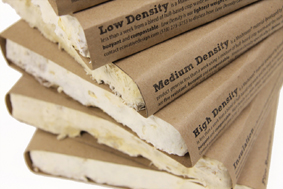
 The 2nd annual Durable Product Award was claimed by Ecovative Design at the RISE conference held by US nonwovens body INDA in Baltimore, Maryland, from October 23-25. This was in recognition of its development of Ecocradle – a natural binder based on mushrooms that can be combined with cotton in new industrial insulation composites.
The RISE show brought together the global nonwovens/engineered materials value chain for two days of thought-provoking, boundary expanding discussions about the latest technical innovations and how they can be applied to help to create value-added, more competitive products.
Some of the highlights included:
- Harvesting ‘Big Data’ to arm product developers and marketing teams with real time data that helps guide future products and enhance current ones.
- Unique optical techniques that utilize modern digital imaging with high-speed digital video cameras to visualize gas flow along with fiber motion which could be particularly beneficial in analyzing melt-blowing polymers.
- How shale gas development in the US could be a game changer as lower cost natural gas could possibly make PE a more attractive alternative to PP and stimulate investment in both in North America.
- Opportunities for bio-based polymers, particularly starch, which is incredibly abundant and inexpensive as well as being sustainable. Through electrospinning and then post-treating the fiber, this could provide new polymer options in the hygiene segment and beyond.
- How one manufacturer has perfected a unique spunbonded 100% polyethylene fabric that is soft with excellent draping, high air permeability, superb uniformity, low irritation to the skin; opportunities are in hygiene, medical, laminations, leather bonding and agriculture.
EcoCradle from Ecovative, meanwhie, uses mushrooms and a nonwoven cotton fabric to produce a unique, easily biodegradable packaging material are just one of the many research projects currently underway at New York-based Ecovative, in collaboration with a range of partners.
Mycelium is a fungal network of threadlike cells similar to the ‘roots’ of mushrooms which is grown from agricultural by-products and likely to have a wide range of applications in future materials.
In 5-7 days it can be grown in the dark, with no watering or petrochemical input needed, by digesting the agricultural by-products and binding them into a structural material – acting like a natural, self assembling glue.
One of the primary roles of fungi in an ecosystem is to decompose organic compounds. Petroleum products and pesticides, typical soil contaminants, are organic molecules – they are built on a carbon structure. This means that they present a potential carbon source for fungi. Consequently, fungi have the potential to remove such pollutants from the soil environment, unless the chemicals prove toxic to the fungus. This biological degradation is a process known as bioremediation.
Mycelial mats have been suggested as having the potential to act as biological filters, removing chemicals and microorganisms from soil and water. The use of fungal mycelia to accomplish this has been termed ‘mycofiltration’.
When spread on logging roads, mycelium can act as a binder, holding new soil in place and preventing washouts until woody plants can be established.
Ecovative’s founders Eben Bayer and Gavin McIntyre have developed a method for manipulating a network of mycelia into desirable shapes, with properties comparable to plastics and other materials, leading to many awards and recent TED Talks with such titles as Are Mushrooms the New Plastic? and Six Ways Mushrooms Can Save the World.
Mycelium is also used to produce mycoprotein involved in the production of quorn (the meat substitute for vegetarians).