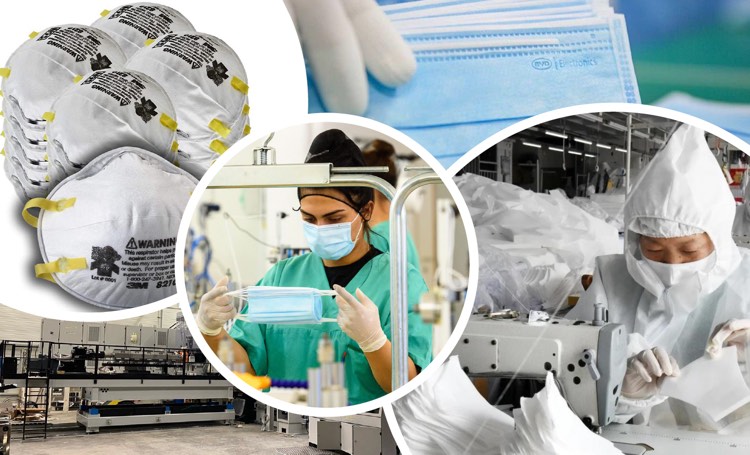
LUBBOCK - An international collaborative facemask research program has received an industry Best Paper Award.
As Seshadri Ramkumar, a Professor at Texas Tech University in the US notes, international collaborations in science, particularly in areas that have global impact are gaining attention. During the recent COVID-19 pandemic, personnel protective equipment such as surgical gowns, face masks and hospital drapes played important roles in offering necessary and added protection to save lives.
The Nonwovens and Advanced Materials laboratory at Lubbock-based Texas Tech University (TTU) has undertook a number of projects to highlight the usefulness of facemasks in controlling the pandemic with a new concept, called FISOR, evolving out of the latest research.
Chennai, India-based Asthagiri Herbal Research Foundation collaborated with the Nonwovens Laboratory at TTU to highlight the accumulation of microbes on facemasks and the need to focus more on hygiene. This collaborative paper was published in the flagship peer-reviewed journal, TAPPI Journal, published by the Technical Association of Pulp and Paper Industry in January 2022.
On February 10, 2023, the paper “Microbial load and proliferation associated with various face mask types and sources during the COVID-19 pandemic," has been recognized as the co-recipient of Best Paper Award for 2022 published in the Journal. In addition, this work is also recognized as the recipient of half of Honghi Tran prize.
The paper can be accessed at: https://imisrise.tappi.org/TAPPI/Products/22/JAN/22JAN23.aspx
"While the work focuses on the importance of face masks, the journal notes that this is the first ever paper in the nonwovens/textiles field to receive the best paper recognition—credible recognition for the growing area of nonwovens," said Ramkumar.
The authors of this paper are Narasimhan Srinivasan, Meenakshi Balakrishnan, James Ayodeji and Seshadri Ramkumar.
Dr. Narasimhan Srinivasan, Chairman of the Asthagiri Herbal Research Foundation has been a colleague of Nobel laureate Herbert Brown and has undertaken research at Purdue University on hydroboration developing chemical reagents.
According to Dr. Narasimhan, “international collaboration provides resources that are complimentary including research expertise to solve common and global problems.”
New areas such as biobased processes and products should provide new avenues for research in textiles and materials science stated Dr. Narasimhan. His research organization is now working on herbal blends that promote immunity, antimicrobial filters and drugs for novel anticancer leads.
"Nonwoven and advanced textiles sector can gain much by multidisciplinary approaches involving organic chemistry, natural products chemistry leading to translational research," said Ramkumar. "Such collaborations are needed as the industry is focusing its attention on sustainability, climate change, etc."