Where will the US and European supply chains that didn’t exist at the start of 2020 be in two years’ time? Frontline developers discuss.
Some of the key issues that face the rapidly-developed new supply chains for face masks and other items of PPE in Europe and the USA were outlined during a round table discussion at the Innovate Textiles & Apparel online textile machinery exhibition on October 21st.
Taking part were Jordan Schindler, CEO of Nufabrx of Conover, North Carolina, Mike Murray, CTO of the Manchester, UK-headquartered Vita Group, Sebastian van de Loo, business developer with engineering consultancy Gherzi, of Zurich, Switzerland, and Sarah Kniehl, sales enginer at ultrasonics specialist Herrmann Ultraschall, of Karlsbad, Germany.
All have been heavily involved in new face mask projects during 2020.
Theramasks
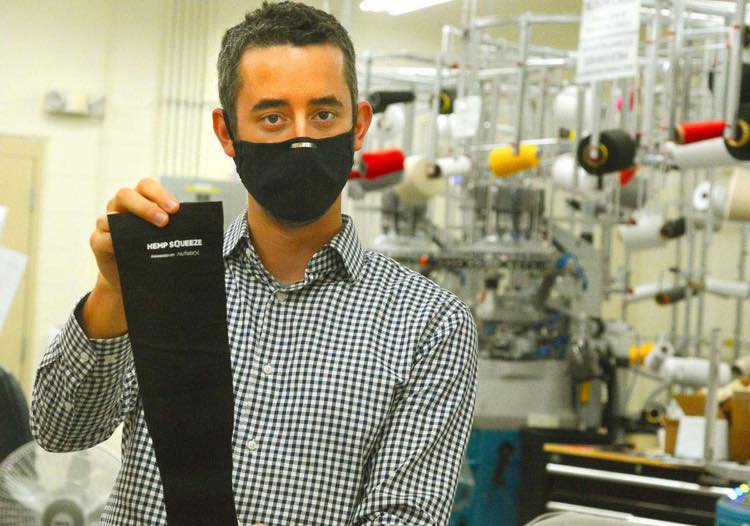
Nufabrx – which is regularly focused on the infusion of therapeutics and medications into fabrics for new health and wellness applications – worked with two other small US companies to develop and launch re-usable face masks for consumers called Theramasks.
Exploiting the antimicrobial benefits of copper, the masks can be washed up to 30 times and consignments are being supplied to US government institutions, organisations such as Fed-Ex, America Airlines and a number of restaurant chains, as well as consumers.
Vita Shield
Vita Group has pivoted production at its PU foam plants in the UK and Slovakia to the production of Vita Shield face coverings for the consumer market. Using three layers of materials that are Oeko-Tex certified for direct skin contact, 90% bacteria efficient Vita Shield masks have been independently approved for prolonged inhalation and may be worn for sustained periods of up to eight hours. They are also washable and reusable up to 10 times.
The Vita Shield VS2 face covering has meanwhile been certified by independent test house Centexbel to have 98% filtration efficiency for 3 micron particles,
Fight – Covid 19’
Gherzi has been involved in the ‘Fight – Covid 19’ project, setting up an entirely new European supply chain for the production of FFP2 protective masks, from the procurement of the appropriate material, ramping up of high-volume production of the masks, and coordination of both processing and distribution.
This directly involved four key companies with 12 more providing asistance to scale up and produce and distribute some 12 million FFP2 masks per month.
The initiative is now pushing for the funding of an integrated nonwovens and face mask line to be set up at a university in Germany, which can be used for research and scaled up for full production in the case of another emergency.
Herrmann Ultraschall has meanwhile been involved in assisting a range of companies from both the nonwovens industry and beyond – such as automotive components supplier Zender – in establishing new lines for face mask production. Hermann set up a mask task force specifically to deal with demand. Ultrasonic bonding has a number of key advantages over sewing or stitching the seams of face masks, in respect of safety and comfort, in addition to speed.
Kniehl said that Herrmann Ultraschall’s task force was still very active, with a lot of face mask manufacturing projects still going on.
“We try to provide the best support and the quick response that’s been needed has really changed our way of working,” she said. “With our technology we can increase the reliability of the mask making process, increasing output and stabilising processes to ensure the masks that enter the market are of good quality and that they are safe, because we have seen many unsafe masks being imported into the EU that aren’t filtering the way they should. We work with government initiatives as much as new players.
“A lot of our long-term partners like the hygiene and medical producers have also modified some of their lines. We have one Italian hygiene customer who has been building face mask machines on a daily basis and we have five technicians there to support that initiative. We are working to help everyone who wants to work in this global team to fight Covid-19.”
Certification
All panelists agreed that the certification and accreditation processes posed some of the key challenges in bringing new face masks rapidly to market.
“It’s such a new industry and there is no standard for reusable masks,” Schindler said. “In the USA, there are six different categories which all overlap, so things are not very clear. Meanwhile people are using everything from N95 masks to the tops of t-shirts as face coverings.
“We were fortunate to get in early, and to work with Nelson Labs – one of the two or three labs in the USA able to certify masks – but as you can imagine they suddenly had a massive backlog, so any iteration or change we wanted to follow back through our testing partners sometimes required between one and two months to get our data back, so it hasn’t been as easy as in normal times.
“Forecasting has also been a nightmare since one day we could be asked by the US government for half a million masks for the following day, and the next day zero, and nobody knows how long this pandemic is going to last.”
Guidance
“For PPE there are specifications but there was nothing on general face coverings at the start,” Murray said. “Centexbel was a really important partner for Vita, but there’s a lack of guidance on materials. The WHO issued guidelines but then France and Belgium brought out their own national standards.
“Now, since June, CEN (the European Committee for Standardization) has a working agreement for face coverings which is very helpful and we’ve been promoting that, but there’s also a lack of guidance on the materials that are actually being used in the masks.”
Lack of unity
Van de Loo said that at the the height of the pandemic, another issue was the lack of unity between EU countries.
“It’s still not clear where we are now,” he said. “Every country is making its own regulations so we have 27 different solutions, which is a real issue. We as an industry need to better this. Surgical masks are also classed as medical devices, so on a certification process, two separate industries with different supply chains have been involved. Meanwhile, there is still no agreement on what is the best protection for the population at large.”
The impact on the lungs of front line workers wearing face masks for up to eight hours is also currently unknown, he added, with FFP2 experts judging four hours to be the maximum such a mask should be worn.
“There is also consumer perception to be taken into account,” Schindler said. “People are not used to masks and complain of finding it hard to breathe. Making masks more breathable is a trade off with filtration efficiency. Should efficiency by 95%, or will 90% suffice for consumer products? It’s really not clear, but it really doesn’t matter at the end of the day if people won’t wear them, and wearing them has also become something of a political issue in the USA, which is a problem. We’re creating a mask infused with moisturiser as one idea to encourage people to wear them. It provides protection but also has a cosmetic benefit for the werarer.”
Here to stay
Discussing return on investment in one or two years’ time, Murray said he believed that face masks are here to stay and will become much more a part of life in the West.
“What we’ve seen with the testing we’ve done with Vita Shield, is that there’s a lot more technology runway to go at, and PPE can be significantly improved from where it is today. Consumers are also confused. At the moment people could be buying anything at all.”
Van de Loo observed that the healthcare buying organisations would be the key to ensuring the longevity of the FFP face mask supply chains that have this year been established in Europe and the USA.
“At the height of the pandemic, prices were sky high, but now they are normalising and these buyers are again looking at China’s prices and expecting to pay what they did before the pandemic,” he said. “They do not care that we have EU labour costs, have to follow government rules and achieve the proper certification. They are buyers, they have their Excel spread sheets and at the end of the year they want their bonuses.
“Governments will argue that the healthcare systems are privatised so have to provide their own goods, so again there is no unity. If price is the only deciding factor, we will see a lot of the initiatives that have been started begin to fade away in the next two years and we will see a lot of bankruptcies in this area. We need to find business models that will support these supply chains.”
Impact
One other key issue is of course, is the environmental impact of face masks.
“We already faced the same problem in the hygiene industry in respect of single-use disposable products like diapers,” said Kniehl.“We have to take the learnings from the hygiene market in respect of more environmentally-friendly fibres and develop stable processes for them in the labs. In the long run we need to be producing masks that will protect not only people but the environment. There’s no team thinking on how we get to closing the loop, and it needs one unified supply chain working together to address this issue.”
“The latest report I read said there are 129 billion face masks being used every month and if they’re all single use or have to be changed every three-to-four hours as we’ve discussed, that number could be even higher,” said Murray. “To have something that is safe, workable, reusable and eventually recyclable – which can be designed into product development – is really important. It poses many challenges but I think ultimately, with the amount of waste this mask wearing is going to generate, we as an industry have to find a solution.”