DORNBIRN – There appears to be something of a disconnect between public procurement policies and the rapid establishment of new PPE supply chains throughout Europe during 2020.
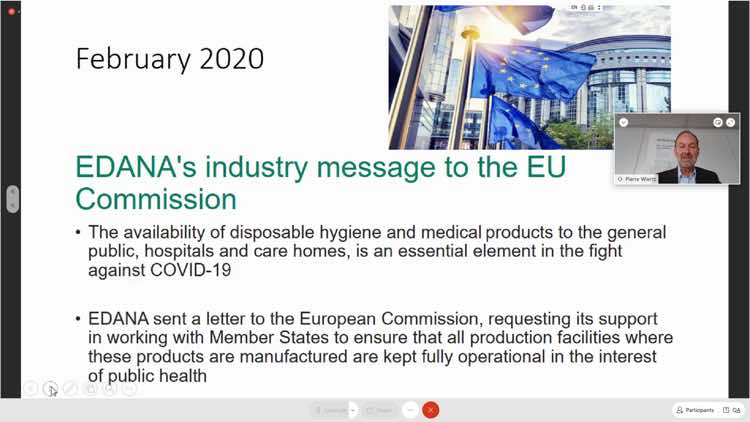
During a session at the virtual Dornbirn 2020 Manmade Fibers Conference on September 17th organised by EDANA – the European Disposables and Nonwovens Association – Henk Vanhoutte, secretary general of the European Safety Federation, spoke of orders for PPE still being placed with China by institutions within Europe, calling for a change in tendering regulations.
“Our politicians have to be responsible and ask themselves what they are doing with public money,” he said. “They have supported companies in investing in Europe to build PPE capacities but when it comes to placing orders it’s all still just about price and we definitely have to get away from that. We really need to look at our rules to make it possible to set up production and keep it alive.”
Getting a long-term commitment to PPE production within the EU is a key sticking point, agreed Thomas Menitz, COO of Lohmann and Rauscher.
“The public procurement tendering process is all driven by price,” he said. “A political decision needs to be made. The EU needs to build in a percentage to be produced locally and the institutions must be true to their promises of developing a self-sufficient industry.”
As a key player in dressing materials and medical devices with a 2019 turnover of €671.5 million, Lohmann and Rauscher had to make rapid adjustments to cope with demand for its masks, gowns and drapes from March onwards, despite the fact that one of its main production plants in Wuhan was closed down for more than eight weeks.
Hygiene Austria is a new company which went from idea to production in just four weeks and is now manufacturing 12 million masks on a monthly basis.
Stephan Trubrich, MD of the joint venture between Lenzing and Palmers in Austria, said a commitment from the EU on market price regulations was badly needed.
“Price discipline must be accepted by the market,” he said.
Pierre Wirtz, secretary general of EDANA, said his organisation was actively advocating at EU level and in calling on the relevant authorities for guarantees of long-term business.
“The EU doesn’t, however, have all of the competence and powers needed to steer the procurement policies of its 27 member states,” he added.
Earlier at the conference, Ruben Dekker, the European Commission policy officer for the circular economy, said that public procurement – accounting for 14% of the EU’s GDP – was one area being examined as part of the Circular Economy Action Plan, which calls for “green and digital twin transition” from industry.
A full report from Dornbirn 2020 will be published in the next print issue of Sustainable Nonwovens.