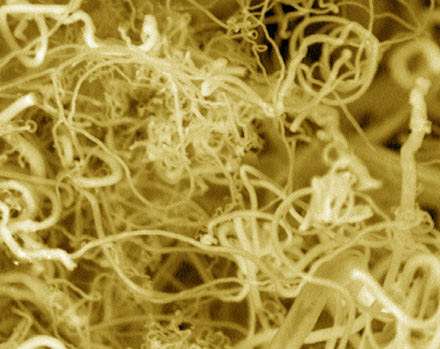
 Researchers at George Washington University have generated significant excitement with the development of a method for taking carbon dioxide directly from the air and converting it into oxygen and nanoscale fibres made of carbon.
Professor of Chemistry Stuart Licht says his group’s newly demonstrated STEP process – which both captures the carbon dioxide from the air and employs an electrochemical process to convert it to carbon nanofibres and oxygen – is more efficient and potentially a lot cheaper than existing methods of producing carbon fibres. At the same time, it captures more solar energy than the most efficient solar cell or photoelectrochemical processes.
“It’s also a means of storing and sequestering carbon dioxide in a useful, stable and compact manner,” says Licht. “If the process is powered by renewable energy, the result is a net removal of carbon dioxide from the atmosphere.”
In a recent demonstration, his group used the unique concentrated solar power system, which makes use of infrared sunlight as well as visible light, to generate the large amount of heat needed to run the desired reaction.