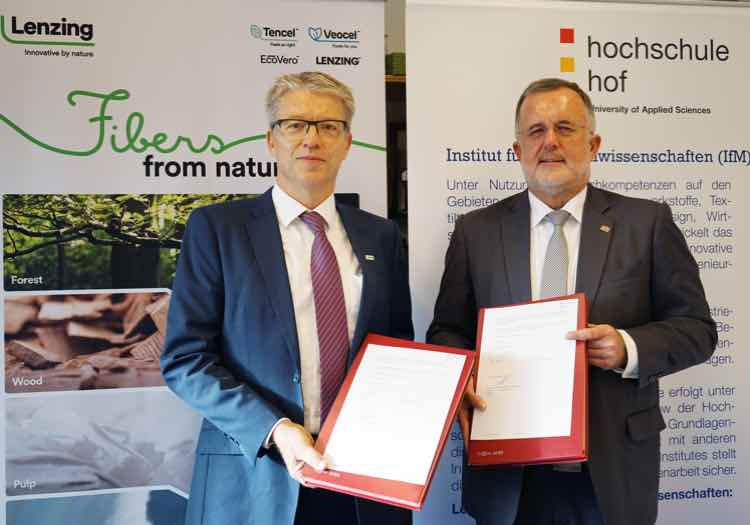
LENZING/HOF - Lenzing and Hof University of Applied Sciences have opened a new Nonwoven Development Center (VEZ), a key aim of which is to support the development of sustainable solutions for the hygiene, body care and medical nonwovens sectors.
As a strategic partner, Lenzing has access to German institution's new spunlacing line and other nonwoven technologies at the campus in Münchberg with immediate effect. This offers new opportunities for sustainable fibre and nonwoven innovations for a wide range of applications across the nonwovens sector.
In line with the sCore TEN corporate strategy, the Lenzing Group says t is focusing on sustainable innovations, which are aimed at meeting the needs of the value chain. The access to the latest state-of-the-art machinery and technologies, which its customers and partners also use to process Lenzing fibres, should enable it to enhance its collaboration with brands and private labels in the cosmetics and hygiene sectors as well helping it explore new wound care products to extend its offering for medical applications. "We offer our customers and partners a decisive competitive advantage - agility," said Jürgen Eizinger, vice president Business Unit Nonwovens at Lenzing. "The pilot plant in the VEZ allows the resource-efficient development of fiber and nonwoven innovations on a small scale. The VEZ was completed in September 2020, after Lenzing and the University of Hof signed a cooperation agreement for its use in 2019. The timing is perfect."
Developments at political level, such as the directive (EU) 2019/904 of the European Parliament and of the Council of 5 June 2019 on the reduction
of the impact of certain plastic products on the environment, are now increasing demand for responsibly manufactured nonwovens. Moreover, the Single-Use Plastics Directive aims at building awareness and greater transparency with regard to wet wipes and feminine hygiene products.
With its Veocel branded wood-based cellulose fibers, Lenzing says it has been laying the foundation for many years for sustainable nonwoven applications and will test and develop innovative ideas using the new possibilities offered by the VEZ.
"We are noticing increasing interest in sustainable concepts from biodegradable cellulose fibres," Eizinger added, summing up the market development of the last few months. "We are aware that the fibres used have an enormous influence on the final product. For this reason our commitment goes beyond fibre production."
With the spunlace pilot plant at the VEZ, as well as supporting customers and partners more intensively in the development of new nonwoven applications, Lenzing will also be able to promote cooperation in marketing . Last year, the company established new certification standards for the Veocel brand and since then, certified manufacturers can only use the Veocel logo with blends of biodegradable cellulose fibres.
As a result, the Veocel brand allows consumers to make more conscious product selections. With its #ItsInOurHands environmental initiative, the Veocel brand also actively contributes to creating awareness.