
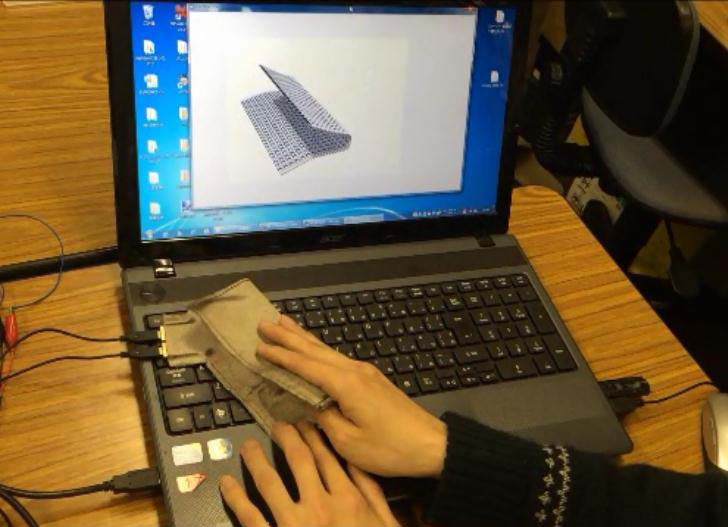
 Teijin is introducing the world’s first piezoelectric fabrics for wearable devices based on both polylactic acid (PLA) and carbon fibres.
They have been developed with Professor Yoshiro Tajitsu of the Faculty of Engineering Science at Kansai University and employ a piezoelectric poly-L-lactic acid (PLLA) and carbon fibre electrode.
Plain, twill and satin weave versions all serve different applications – the plain weave detects bending, the satin weave twisting and the twill weave three-dimensional motion, as well as bending and twisting.
The sensing function, which can detect arbitrary displacement or directional changes, incorporates Teijin’s weaving and knitting technologies and allows fabric to be applied to the actuator or sensor to detect complicated movements – even in three dimensions.
Kansai University and Teijin will continue working on ideal weaves and knits for fabric applications which enable elaborate human actions to be monitored simply via clothing worn. These are expected to contribute to the evolution of the Internet of Things (IoT) in fields ranging from elderly care to surgery, artisanal techniques, space exploration and many others.
Piezoelectricity is the ability of certain dielectric materials to generate an electric charge in response to mechanical stress. It also has the opposite effect – the application of electric voltage produces mechanical strain in the materials. Both of these effects can be measured, making piezoelectric materials effective for both sensors and actuators.
Lead zirconate titanate (PZT) has practical piezoelectric applications in industry, but as a ceramic material it lacks transparency and flexibility. In addition, because PZT contains lead, applications are being increasingly limited by the EU directive that restricts the use of certain hazardous substances in electrical and electronic equipment.
Polyvinylidene fluoride (PVDF) is a well-known piezoelectric polymer but it is limited to use in sensors and not suited to industrial-level manufacturing because it requires poling treatment and exhibits pyroelectricity. Poling treatment, which involves applying high DC voltage to a material, is a required process for achieving piezoelectricity. Pyroelectricity is the ability of certain materials to generate a voltage and charge following a change in temperature. The existence of pyroelectricity is a very important factor in human-machine interface (HMI) applications because if a piezoelectric sensor material has pyroelectricity, it can immediately detect heat from a finger.
In 2012, Kansai University and Teijin developed a flexible, transparent piezoelectric film by alternately laminating PLLA and optical isomer poly-D-lactic acid (PDLA). The all-new wearable piezoelectric fabric is the latest application of this technology.