 New ion exchange fibres are being developed from acrylic in Japan and cellulose in Europe.
As the basis of nonwovens, they could find useful applications in the water and gas purification, precious metal recovery and effluent treatment markets.
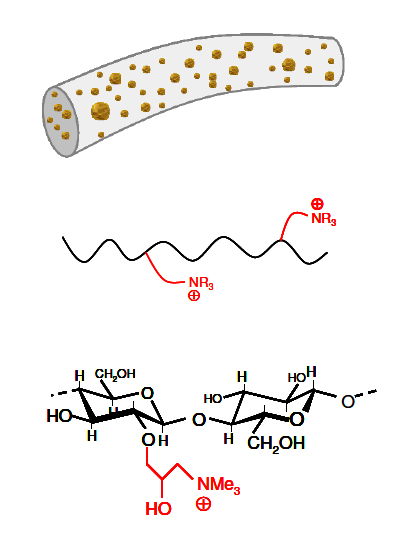
Osaka-headquartered Kaneka Corporation is introducing a reactive polymer into its Kanecaron acrylic during fibre spinning. Ion exchange is an exchange of ions between two electrolytes or between an electrolyte solution and a complex. In most cases the term is used to denote the processes of purification, separation, and decontamination of aqueous and other ion-containing solutions with solid polymeric or mineralic ‘ion exchangers’. Typical ion exchangers are functionalized porous or gel polymer resins beads, as well as zeolites, montmorillonite, clay and soil humus.
At the recent Dornbirn Manmade Fibre Conference, Yusuke Hirai said that Kaneka’s new fibre can be used as the basis of woven or nonwoven structures that are characterised by an extremely large surface area capable of rapid adsorption, potentially opening up new application markets.
Similar developments have been made with viscose in Europe, and Dr Roland Scholz of Kelheim Fibres, based in Kelheim, Germany, said that the company’s Poseidon, Verdi and Deep Dye variants have been ionically activated to provide a broad spectrum of properties.
In applications such as water softening and the removal of contaminants from water, these fibres deliver extremly high exchange rates up to ten times faster than resin beads, although the advantage depends on the process.