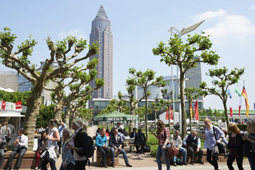
T here was little sense of an ongoing Euro Crisis at this week’s Techtextil trade show in Frankfurt, with packed halls and visitor numbers well ahead of previous editions.
The event attracted some 1,322 exhibiting companies from 48 countries, with the national presence of many – even trouble-hit Spain – at record new levels. A further 326 companies took part in the less well established but growing Texprocess event for textile processing.
On Wednesday, details were provided of the success of the European Economic and Social Committee (EESC) in having an initiative opinion overwhelmingly adopted in April. This should result in a much greater awareness of, and support for, the technical textiles and nonwovens industries at European Union level.
The EESC consists of some 344 people in 27 member states and its adoption of the opinion, explained vice-president Jane Morris, casts technical textiles as a traditional industry which has reinvented itself, with key innovations that could respond to a huge variety of social challenges.
It draws the attention of the European Commission and the European Parliament to the major success factors which need to be encouraged in order to foster further growth.
It calls for simple and efficient means of financing innovation at both national and EU levels and for EU R&D programmes to include a textile component, with the aim of replacing traditional materials such as steel and cement, and to strengthen the research into both recycling and the evolving field of the CO2 economy.
It also particularly draws attention to the effect of any energy cost increases to EU companies in the nonwovens and composites sectors and to support life cycle assessment in order to demonstrate the environmental sustainability of products.
In figures drawn from a number of sources, the opinion puts the global technical textile market in 2011 at 40.6 million tonnes, with a value of US$253 billion.
Of this figure, technical textiles account for 25 million tonnes ($133 billion) with the EU having a 20% share. Annual growth is around 3%.
The nonwovens market is put at 7.6 million tonnes ($26 billion) and the EU’s share is around 25%, with annual growth of 6.9%, while composites add a further 8 billion tonnes with a value of $94 billion. The EU’s share of this last market is 33%, with annual growth of 6%.
More details in the next print issue of Sustainable Nonwovens.