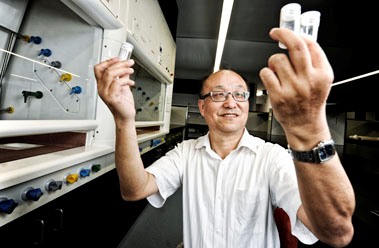
 Researchers at Queensland University of Technology (QUT) have developed a new absorbent based on titanate nanofibres and nanotubes capable of removing radioactive material from contaminated water.
It is thought the material could also solve the problem of how to clean up millions of tonnes of water contaminated by dangerous radioactive material and safely store the concentrated waste.
Professor Huai-Yong Zhu from QUT Chemistry says the intelligent absorbent differs from current clean-up methods, such as layered clays and zeolites because it can efficiently lock in deadly radioactive material from contaminated water.
The absorbents can then be safely disposed of without the risk of leakage, even if the material becomes wet.
“One gramme of the nanofibres can effectively purify at least one tonne of polluted water,” said Professor Zhu. “This saves large amounts of dangerous water needing to be stored somewhere and also prevents the risk of contaminated products leaking into the soil.”
The technology, which was developed in collaboration with the Australian Nuclear Science and Technology Organisation (ANSTO) and Pennsylvania State University in the USA, works by running the contaminated water through the fine nanotubes and fibres, which trap the radioactive Cesium (Cs+) ions through a structural change.
“Every year we hear of at least one nuclear accident,” said Zhu. “Not only is there a risk of contamination where human error is concerned, but there is also a risk from natural disasters such as we saw in Japan in 2011.”
Professor Zhu and his research team believed the technology would also benefit industries as diverse as mining and medicine.
By adding silver oxide nanocrystals to the outer surface, the nanostructures are able to capture and immobilise radioactive iodine (I-) ions used in treatments for thyroid cancer and in probes and markers for medical diagnosis.
“It is our view that just taking the radioactive material in the adsorbents isn’t good enough. We should make it safe before disposing it,” said Zhu. “The same goes for Australian sites where we mine nuclear products. We need a solution before we have a problem, rather than looking for fixes when it could be too late.
“In France, 75 per cent of electricity is produced by nuclear power and in Belgium, which has a population of 10 million people, there are six nuclear power stations Even if we decide that nuclear energy is not the way we want to go, we will still need to clean-up what’s been produced so far and store it safely.
“Australia is one of the largest producers of titania that are the raw materials used for fabricating the absorbents of titanate nanofibres and nanotubes. Now with the knowledge to produce the adsorbents, we have the technology to do the cleaning up for the world.”